
3 business benefits of Dell Private Cloud
Enterprise infrastructure requirements are evolving rapidly. Spurred on by surging data volumes, virtualization, and cumbersome AI workloads, IT leaders are scrambling to modernize infrastructure environments and optimize their IT estates.
IDC's 2026 Cloud FutureScape report shows that private cloud is experiencing somewhat of a renaissance. Indeed, nearly half (40%) of large enterprises are expected to adopt private cloud for AI workloads by 2028, for example.
Private cloud has traditionally been viewed as more complex compared to plug-and-play approaches such as public cloud. However, now IT leaders see it as an attractive opportunity.
Modern private cloud solutions provide flexibility and simplicity in one secure package - and simplification is a key focus for IT leaders at present.
Decades of IT overhauls, hardware adoption processes, and digital transformation efforts have resulted in increasingly complex IT environments.
Enterprises now host a sprawling variety of workloads while contending with outdated hardware that can't keep pace with the pressure - and costs - created by technologies such as artificial intelligence.
Solutions such as Dell Private Cloud address these challenges directly, enabling enterprises to overhaul and modernize their IT infrastructure through a centralized platform. At the same time, it provides frontline workers with a range of intuitive automation and AI-powered features to streamline processes.
So how can businesses benefit from Dell Private Cloud?
1. Simplified infrastructure
Underpinning Dell Private Cloud is the Dell Automation Platform. It is designed to streamline both adoption and administration of IT infrastructure.
This provides users with blueprint-driven workflows designed to help automate deployment processes, as well as management capabilities. For longer-term maintenance, the platform also provides automation features designed to simplify lifecycle management.
These automated lifecycle management features help ensure your IT environment "stays optimized over time" and provide updates as and when they're needed.
Automation capabilities aren't restricted to maintenance and management, however. For enterprises, scalability is a key factor in choosing the right hardware, and Dell Private Cloud offers intelligent configuration capabilities. This allows users to easily scale clusters or add nodes based on changing requirements.
2. Flexible infrastructure
Flexibility is a key factor for IT leaders when considering IT infrastructure modernization. Vendor lock-in has rapidly become a recurring pain point for organizations, keeping them confined within the same walled gardens
Dell Private Cloud, meanwhile, provides an "open, disaggregated architecture" for users. Put simply, this means enterprises can deploy their own preferred third-party OS licenses, such as Azure Local, Red Hat, Nutanix, or VMware - all on Dell hardware.
This "bring-your-own-licenses" approach provides marked flexibility improvements for IT leaders, allowing them to essentially mix and match solutions while operating on a trusted infrastructure foundation.
3. Future proofing
Given the rapid changes to infrastructure over the last five years alone, IT leaders are naturally thinking ahead as their digital transformation and AI adoption projects accelerate and mature.
Dell Private Cloud is adaptable and designed to meet the business needs of today and the demands of tomorrow, too.
The platform allows users to scale private cloud infrastructure based on changing needs. Underpinned by the aforementioned automation features, this means that scaling your IT estate to contend with additional pressure is no longer a potentially lengthy and expensive process.
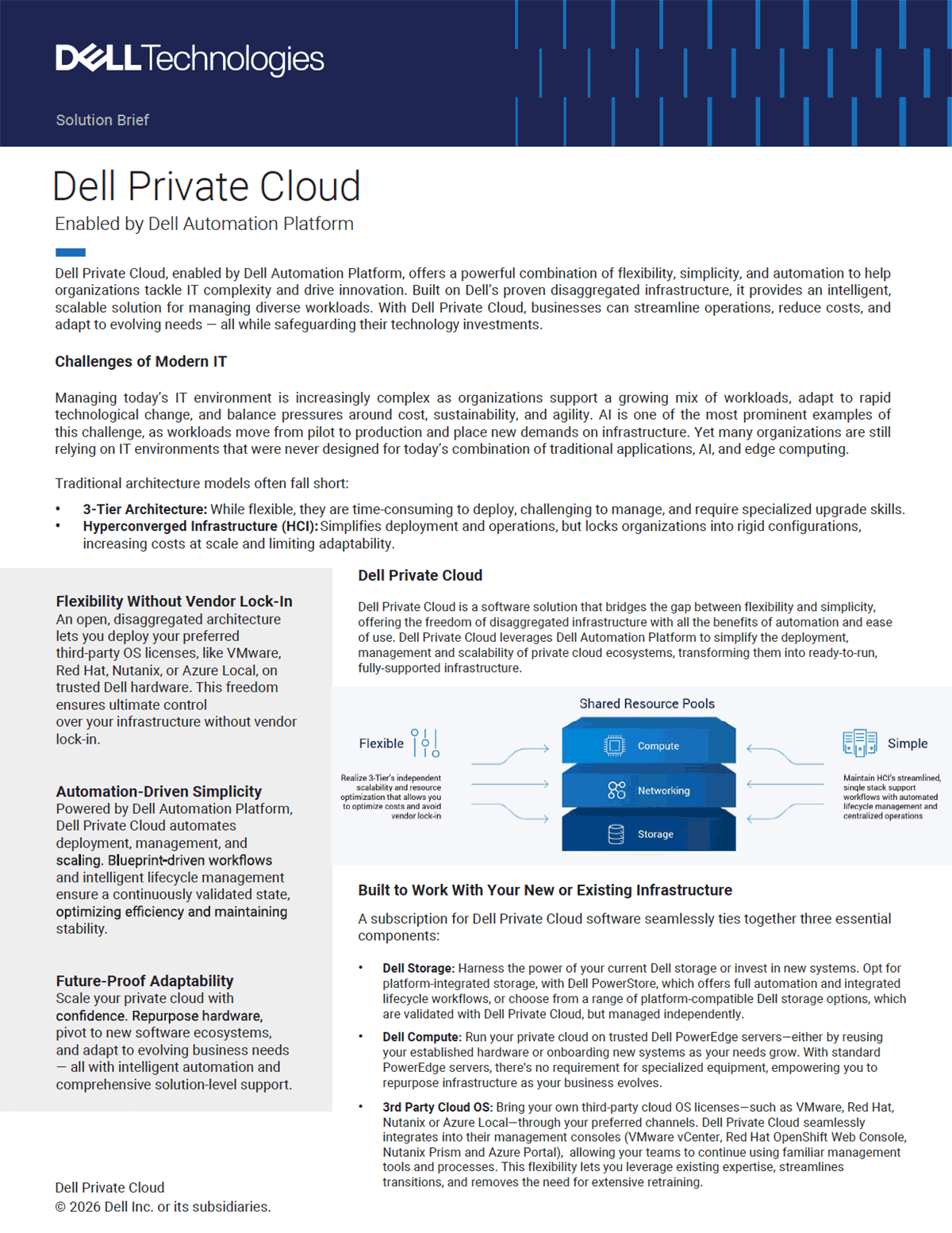
If you'd like to learn more about how Dell Private Cloud can help your business, download the solution brief, 'Dell Private Cloud - Enabled by Dell Automation Platform.'
Please provide citations & attributions for any information you generate from this content, thank you.