
High performance, low latency, greater efficiency: how the Dell PowerStore 9500 array enhances any modern data center

Growing data volumes and demanding applications are putting more pressure on enterprise storage to deliver high throughput without increasing latency or infrastructure overhead.

Dell PowerStore 9500 is a high-performance, high-density platform in a compact 3U chassis. It supports up to 40 drives and independent scaling of performance and capacity.

In testing by Principled Technologies, commissioned by Dell, PowerStore 9500 was compared with a current-generation all-NVMe array using simulated OLTP and database workloads. The testing covered storage performance and data reduction, with IOPS and latency measured across the workloads.

Performance without the bottlenecks

High storage performance helps databases and other latency-sensitive applications process requests quickly, while reducing the risk of storage becoming a bottleneck for compute resources.

In transactional environments, such as financial systems or ERP platforms, higher throughput can support more concurrent activity while keeping response times predictable.

In the OLTP with analytics workload used by Principled Technologies, the PowerStore 9500 delivered 834,558 average IOPS, compared with 357,427 for Vendor A - 2.33 times the performance.

In a separate database test targeting 310,000 IOPS, PowerStore 9500 recorded 63.94% lower latency. Its latency was also more consistent across the test, which can help applications maintain steadier response times under changing workloads.

Getting more from the same footprint

Storage efficiency depends on both physical density and how effectively the system reduces the amount of data that needs to be stored.

PowerStore 9500 supports up to 40 drives in a 3U chassis, which equates to 11% more drives per rack unit than Vendor A's 48-drive, 4U design.

Principled Technologies also measured data reduction using a controlled dataset. PowerStore 9500 achieved a 6.6:1 data reduction ratio, compared with 2.76:1 for Vendor A.

Greater physical density and stronger data reduction can help organizations fit more usable capacity into existing rack space, while reducing the number of drives and systems needed as storage requirements grow.

Designed to grow with demand

PowerStore 9500 can expand capacity one drive at a time, while allowing performance and capacity to scale independently. The platform also supports data-in-place upgrades and mixed-generation clustering across PowerStore models, helping businesses extend the life of existing infrastructure as requirements change.

See how the results were achieved

The full Principled Technologies report sets out the hardware configurations, Vdbench workloads, test environment, and methodology used to compare PowerStore 9500 with Vendor A, and includes the complete performance, latency, and data-reduction results behind the headline findings.

To explore the testing in detail and see how PowerStore 9500 performed across each workload, download the full report, 'Dell PowerStore 9500: Higher performance, lower latency, and greater storage density than a competing array.'
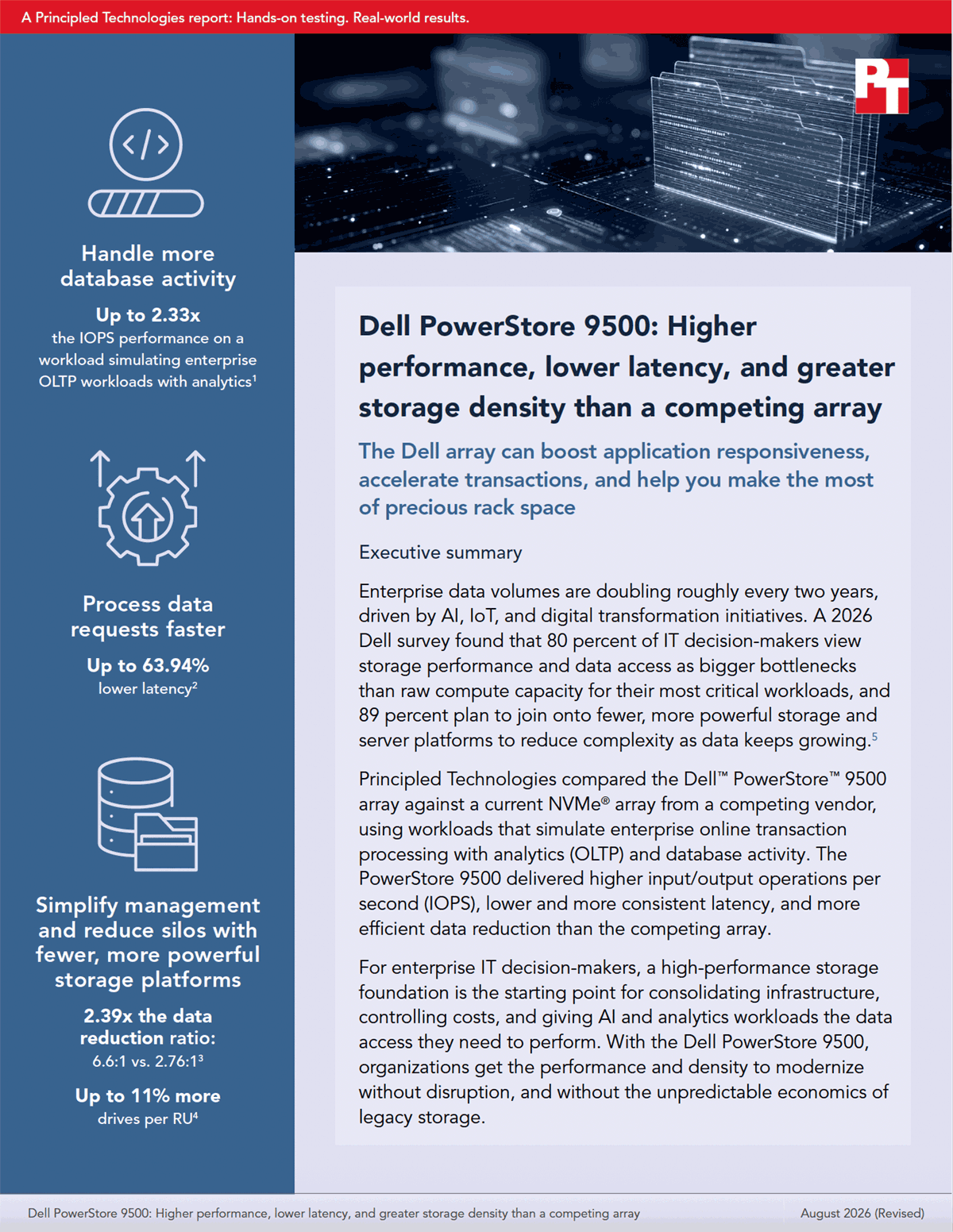
 

High performance, low latency, greater efficiency: how the Dell PowerStore 9500 array enhances any modern data center
A Principled Technologies report: Hands-on testing. Real-world results. August 2026 (Revised) ## **Handle more database activity** **Up to 2.33x** the IOPS performance on a workload simulating enterprise OLTP workloads with analytics1 **Process data requests faster** **Up to 63.94%** lower latency2 **Simplify management **and reduce silos with** fewer, more powerful storage platforms** **2.39x the data reduction ratio:** 6.6:1 vs. 2.76:13 **Up to 11% more** drives per RU4 # **Dell PowerStore 9500: Higher performance, lower latency, and greater storage density than a competing array** **The Dell array can boost application responsiveness, **accelerate transactions, and help you make the most** of precious rack space** ## Executive summary Enterprise data volumes are doubling roughly every two years, driven by AI, IoT, and digital transformation initiatives. A 2026 Dell survey found that 80 percent of IT decision-makers view storage performance and data access as bigger bottlenecks than raw compute capacity for their most critical workloads, and 89 percent plan to join onto fewer, more powerful storage and server platforms to reduce complexity as data keeps growing.5 Principled Technologies compared the Dell™ PowerStore™ 9500 array against a current NVMe® array from a competing vendor, using workloads that simulate enterprise online transaction processing with analytics (OLTP) and database activity. The PowerStore 9500 delivered higher input/output operations per second (IOPS), lower and more consistent latency, and more efficient data reduction than the competing array. For enterprise IT decision-makers, a high-performance storage foundation is the starting point for consolidating infrastructure, controlling costs, and giving AI and analytics workloads the data access they need to perform. With the Dell PowerStore 9500, organizations get the performance and density to modernize without disruption, and without the unpredictable economics of legacy storage. ## Why does storage performance matter? Strong performance in enterprise storage arrays **improves application responsiveness, user experience, and overall productivity**. High-throughput, low-latency storage ensures that databases, analytics platforms, and other mission-critical workloads operate efficiently even under heavy demand. This translates to faster decision-making, reduced wait times for employees and customers, and the ability to handle peak loads without degradation. In competitive industries, these performance gains can differentiate customer experiences and support revenue growth by enabling real-time services and insights. High-performance storage also **improves infrastructure efficiency and cost optimization**. Faster arrays can consolidate workloads that would otherwise require multiple systems, reducing hardware footprint, power consumption, and management complexity. They also utilize compute resources better by eliminating storage bottlenecks, ensuring that expensive CPUs and memory are not left idle waiting for data. **Enhanced resilience and future readiness** are additional benefits of strong storage performance. Modern enterprises increasingly rely on data-intensive technologies such as AI, machine learning, and large-scale analytics, all of which demand rapid data access and movement. A high-performance storage foundation enables organizations to adopt these innovations without costly rearchitecture. It also supports faster backup, recovery, and replication processes, reducing downtime and strengthening business continuity. ## Why does storage density matter? High storage density in enterprise arrays maximizes the amount of data stored within a given physical footprint. There are two primary ways to achieve greater density: by **increasing the raw physical storage capacity** per rack unit and by using **data reduction techniques** to more efficiently utilize the raw storage you have. By choosing a storage array that offers advantages in both of these areas, companies win twice. By packing more usable capacity into fewer rack units, organizations can **reduce their need for data center space**, an increasingly scarce and expensive resource. This is especially important in colocation facilities or urban data centers where floor space comes at a premium. Higher storage density lets businesses scale capacity without expanding their physical infrastructure, enabling more efficient growth and better utilization of existing facilities. Increasing storage density through more compact architecture and stronger data reduction also drives meaningful **reductions in operational costs**. You can buy fewer drives both initially and over time as data volumes increase, which translates to lower power and cooling requirements, reduced cabling complexity, and less hardware to maintain. These efficiencies translate into ongoing savings in energy consumption and administrative overhead, while also supporting corporate sustainability goals. In addition, denser systems can simplify procurement and deployment, enabling IT teams to choose the most efficient expansion model for their environment—whether that's granular, single-drive growth or periodic larger-scale expansions. Another advantage of a system that provides more room for storage expansion without adding additional appliances is that it simplifies lifecycle management. # How the Dell PowerStore 9500 supports your business goals The Dell PowerStore 9500, part of the next generation of PowerStore hardware, is a high-performance, high-density enterprise storage platform that revolutionizes capacity and lifecycle economics in a compact 3U chassis.⁶ * **Performance.** Noteworthy features driving performance include next-generation Intel® CPUs, DDR5 memory, PCIe 5.0, end-to-end NVMe, and software-driven performance optimization. * **Storage density.** For significant rack space consolidation and future-proof density, the array: * Supports up to 40 drive slots in just 3U, leveraging industry-standard high-performance EDSFF E3.S NVMe SSDs * Supports single-drive expansion * Supports always-on data reduction across the entire array, supports up to 5.8 PBe of data per appliance at a data reduction ratio of 6:1, and comes with the Dell data reduction guarantee * **Modular, flexible architecture.** Organizations can scale performance and capacity independently without downtime, and adapt to changing workloads with support for both traditional and modern applications in a unified storage platform.⁷ ## Why this matters for CIOs Generation 3 of PowerStore hardware is suited for consolidation of mixed workloads (streaming, backup, ETL, VM mobility) where density, performance scalability, and long-term upgradability are priorities.⁸ Benefits include: * **Lower TCO and footprint.** Significantly higher performance density and efficiency than prior generations, enabling consolidation of workloads onto fewer systems, which can reduce power, cooling, and operational overhead.⁹ The ability to fit 40 drives in only 3U means greater I/O density. * **Keep pace with ongoing technology and growing storage requirements.** Supports data-in-place upgrades and flexible scale-out with mix-and-match clustering across all PowerStore models and generations. * **Protect your investment.** Optional Lifecycle Extension program, a separate add-on, entitles customers to a flexible technology upgrade (higher model, next gen, or scale-out credit) as well as additional benefits including a 25 percent capacity discount and annual modernization consultations.¹⁰ * **Enjoy flexible performance and media choices.** The Dell PowerStore 9500 supports QLC and TLC E3 flash (multiple capacities) with SED/FIPS options, and broad I/O network headroom (OCP 3.0 and NVMe-oF) to accommodate evolving workloads. # How did we approach testing? We ran identical Vdbench block tests on the Dell PowerStore 9500 and the competing all-NVMe enterprise array from Vendor A to compare: * IOPS on a simulated OLTP workload * Latency at matched target IOPS * Data reduction with a controlled dataset ## Storage array hardware configuration Table 1: Key configuration details of the arrays we tested. | PowerStore 9500 | Competing all-NVMe enterprise array from Vendor A | | —- | —- | | 24 x 3.5TB drives | 32 x 3.5TB drives | | 2 x storage nodes | 2 x storage nodes | | 16 x 64Gb Fibre Channel ports (8 on each node) | 16 x 64Gb Fibre Channel ports (8 on each node) | | 2 TB total RAM | 2 TB total RAM | ## Test environment * 4 x ESXi hosts, each with 4 x Linux VMs and 4 x 32Gb ports * 16 x Fibre Channel ports from the hosts and 16 x Fibre Channel ports from the storage array connected to a 32Gb Fibre Channel switch * Vdbench as the workload generator * Median results from three runs per test phase reported ## About the Dell PowerStore 9500 and Dell Private Cloud The Dell PowerStore 9500 is the modern data foundation of Dell Private Cloud, delivering performance, efficiency, and flexibility to support both traditional and modern workloads without re-architecting existing environments. Dell describes Dell Private Cloud as enabling organizations to "deploy and run their preferred cloud stack from vendors like Broadcom, Microsoft, Nutanix and Red Hat on open, disaggregated Dell infrastructure with automated lifecycle management,"11 scaling "compute and storage independently" and delivering "up to 65% cost savings versus HCI."12 Dell positions PowerStore as "a proven foundation for private clouds,"13 noting that customers can deploy it "on open, disaggregated infrastructure"14 without rearchitecting their existing stack. The performance and data reduction testing conducted for this report speaks directly to that foundation: the array-level IOPS, latency, and storage-efficiency gains help make PowerStore a viable base for private cloud deployments. Cyber resilience capabilities and the operational automation of Dell Private Cloud were outside the scope of this study. # What did our testing reveal? ## Higher OLTP + analytics throughput The workload we used quantifies a storage system's ability to handle highly transactional, small-block, random I/O patterns typical of real-world OLTP databases and to sustain demanding workloads efficiently, helping organizations scale operations while maintaining responsiveness and reliability. Ideally, a system delivers high levels of IOPS, low latency, and consistent performance during peak demand, which is critical for applications such as financial systems, order processing, and ERP platforms. Higher throughput and lower latency for this workload also reduce contention within the database, enabling more concurrent users and transactions without degradation. In virtualized environments, this means greater VM density and fewer performance bottlenecks. For database administrators, it allows tighter service-level objectives and improved user experience. As Figure 1 shows, the Dell PowerStore 9500 array delivered 2.33 times the performance of the competing all-NVMe enterprise array from Vendor A. | Storage Array | Average IOPS | | —- | —- | | Dell PowerStore 9500 | 834,558 | | Vendor A | 357,427 | ### **Testing details** * Read-heavy, 8KB mixed I/Os with 128KB sequential large reads and writes to mimic index/table scans, batch queries, and background analytics * Random reads/writes: 65%/15% * Sequential reads/writes: 10%/10% * Average weighted I/O size: 32 KB * Runtime: 5 minutes (including 30-second warmup) for each thread setting ### **Key takeaway** The Dell PowerStore 9500 array delivered 2.33 times the performance of the competing all-NVMe enterprise array from Vendor A on the Vdbench OLTP with analytics workload. ## Lower latency at target IOPS Lower latency in enterprise storage significantly improves overall system performance by reducing the time it takes to process each data request. This leads to faster application response times, which is especially critical for latency-sensitive workloads such as databases, virtualization platforms, and real-time analytics. With quicker I/O completion, systems can handle more operations per second, increasing throughput without requiring additional hardware. Lower latency also minimizes bottlenecks, allowing CPUs and GPUs to operate more efficiently rather than waiting on storage, and enables higher virtual machine density in consolidated environments. To compare the latency of our two test arrays, we conducted a different database test with mixed I/O sizes and set a target of 310,000 IOPS. We ran the test for 5 minutes. As Figure 2 shows, the Dell PowerStore 9500 array reduced latency by 63.9 percent compared the competing all-NVMe enterprise array from Vendor A. ### Latency when achieving a target of 310K IOPS in database testing with mixed I/O sizes | Storage Array | Latency (ms) | | —- | —- | | Dell PowerStore 9500 | 0.44 | | Vendor A | 1.22 | ### **Key takeaway** The Dell PowerStore 9500 array reduced latency by 63.94 percent compared to the competing all-NVMe enterprise array from Vendor A with a target of 310,000 IOPS in a database test with mixed I/O sizes. The latency of the Dell PowerStore 9500 array was not only lower, on average, than that of the competing all-NVMe enterprise array from Vendor A, but was also much more consistent. While the Vendor A array delivered an average latency of 1.223 ms, results ranged from a minimum of 0.438 ms to a maximum of 15.214 ms. In contrast, latency on the Dell PowerStore 9500 array ranged from 0.397 ms to 0.586 ms, with an average of 0.441 ms. (See complete test results in the science behind the report: https://www.delltechnologies.com/asset/en-us/products/cross-company/industry-market/principled-technologies-powerstore-9500-vs-vendor-a-performance-density-science.pdf.) Low variability in storage array latency ensures more predictable and consistent performance, which is critical for applications that depend on steady response times, such as databases and real-time systems. It also reduces the risk of performance bottlenecks and improves overall system reliability under varying workloads. # How do data reduction capabilities maximize effective capacity and reduce footprint? Data reduction technologies—including compression and deduplication—are critical in reducing storage requirements and associated costs and delaying the need for costly capacity upgrades. This leads to better system performance and minimizes downtime in critical operations. Dell PowerStore arrays use always-on data reduction to automatically eliminate redundant data as it's written, maximizing storage efficiency without requiring manual configuration. This inline, real-time process reduces capacity needs and lowers costs while maintaining consistent performance.15 ## How did we measure data reduction? To measure the data reduction capabilities of the two arrays, we used Vdbench single thread, 256KB sequential write to pre-fill the 64 logical unit numbers (LUNs) with 2:1 compression, 2.5:1 deduplication, and an 8KB deduplication unit. We used the graphical user interface to check the data reduction after the pre-fill and again after 1 hour. As Figure 3 shows, the Dell PowerStore 9500 achieved a data reduction ratio of 6.6:1, 2.39 times that of the 2.76:1 ratio achieved by the competing all-NVMe enterprise array from Vendor A. In addition to a higher DDR, the Dell PowerStore array also has 11 percent more drives per rack unit (40 drives in 3 RU vs. the Vendor A array's 48 drives in 4 RU). Together, these factors support can improve storage efficiency, simplify management, and reduce silos with fewer, more powerful platforms. | Array | Data reduction ratio | | —- | —- | | Dell PowerStore 9500 | 6.6:1 | | Vendor A | 2.76:1 | ### **Key takeaway** The Dell PowerStore 9500 achieved a data reduction ratio of 6.6:1, 2.39 times that of the 2.76:1 ratio achieved by the competing all-NVMe enterprise array from Vendor A. With this improved DDR and 11 percent more drives per rack, the PowerStore 9500 lets organizations consolidate onto fewer, more powerful storage platforms. ## The Dell data reduction guarantee Understanding the customer value of data compression and deduplication technologies, Dell Technologies™ set out to develop the best data reduction capabilities in the industry. PowerStore data reduction is always on across the entire array, which means administrators don't need to toggle it on or manage it on a per-workload basis. Dell is so confident in its already industry-leading data reduction capabilities and commitment that it now guarantees that customers purchasing any Generation 3 Dell PowerStore model will experience a 6:1 data reduction ratio on reducible data.16 Dell includes this guarantee automatically and requires no signature or assessment. ## Conclusion The Dell PowerStore 9500 delivers a compelling combination of strong performance, low latency, and high data density that addresses the demands of modern, data-intensive enterprises. Based on the Vdbench comparisons in this report, the Dell PowerStore array consistently outperformed the competing all-NVMe enterprise array from Vendor A across OLTP with analytics workload profiles, while also reducing response times and requiring less physical capacity to store equivalent data. These advantages translate into tangible benefits for IT organizations: faster transaction processing and improved user experience, higher VM and database consolidation ratios, reduced rack footprint and operational overhead, and greater flexibility to support emerging workloads such as analytics and AI. Choosing the Dell PowerStore 9500, part of the Dell PowerStore Gen 3 platform, can help your organization lower total cost of ownership and simplify infrastructure while delivering the performance and scalability needed to keep pace with accelerating data growth and business demands. # FAQ ## **What tests did Principled Technologies run to compare the arrays?** We ran identical Vdbench block tests on both arrays, measuring: * IOPS on an OLTP with analytics workload profile (OLTPA.vdb) * Latency at matched target IOPS * Data reduction using a controlled dataset ## **What workloads did Principled Technologies use and why?** We tested with two workloads: * OLTPA.vdb: Mixed small-block random I/O plus large sequential reads/writes to simulate OLTP with analytics (batch/scan activity) * Database test with mixed I/O sizes: Used to set target IOPS and compare latency ## **What were the key performance results?** Compared to the competing all-NVMe enterprise array from Vendor A, the PowerStore 9500 array delivered 2.33 times the performance on the OLTPA.vdb workload. It reduced latency by 63.94 percent on the same database set with matched target IOPS. ## **Are these performance results transferable to other workloads?** Strong I/O performance on an OLTP benchmark can suggest a system is optimized for handling high-throughput, latency-sensitive operations, which may translate to solid performance on other workloads. However, this is not guaranteed, as different workloads can stress entirely different subsystems, access patterns, and resource bottlenecks. ## **How did Principled Technologies measure data reduction and what were the results?** We pre-filled 64 LUNs using Vdbench single-thread 256KB sequential writes with dataset characteristics (2:1 compression, 2.5:1 deduplication, and an 8KB deduplication unit), then checked each array's data reduction after a defined interval. The Dell PowerStore array achieved a data reduction ratio of 6.6:1, compared to a ratio of 2.76:1 for the competing all-NVMe enterprise array from Vendor A. ## **Does Dell guarantee data reduction?** **Yes.** Dell guarantees a 6:1 data reduction ratio on reducible data for any new Dell PowerStore Gen 3 model; the guarantee is included with the array and requires no signature or assessment. ## **What are the primary hardware and density differences between the two test arrays?** The Dell PowerStore 9500 has a compact 3U chassis that fits 40 E3 drives (E3.S NVMe SSDs), supports up to 5.8 PBe per appliance at 6:1 DRR, and offers always-on data reduction and modular, non-disruptive upgrades. The competing all-NVMe enterprise array from Vendor A includes 32 x 3.5TB drives (~90 TiB available), 16 x 64Gb Fibre Channel ports, and PCIe Gen 5 slots. ## **Based on these comparative results, what operational and business benefits can the Dell PowerStore 9500 provide?** Key potential benefits include: * Improved application responsiveness and higher throughput * Lower latency for latency-sensitive workloads * Higher storage density (more drives/hosts per U) and lower rack footprint * Lower TCO via consolidation, reduced power/cooling, and lifecycle upgradeability * Programs from Dell that can provide non-disruptive controller upgrades and discounted capacity expansion, which may improve lifecycle economics compared to traditional refresh cycles 1. Vdbench OLTPA.vdb performance test. 2. Latency in a database test with mixed I/O sizes. 3. Data reduction ratios achieved by the two test arrays with the same reducible data set. 4. The Dell PowerStore array has 40 drives in 3 RU vs. the Vendor A array's 48 drives in 4 RU. 5. Dell Technologies, "Modern Enterprise Readiness Study," accessed August 4, 2026, https://www.delltechnologies.com/assetlink/doc/en-us/modern-enterprise-readiness-study-2026-full-findings-en-dl114jsw-original.pdf. 6. Dell Technologies, "PowerStore Gen3 Spec Sheet," accessed May 11, 2026, https://www.delltechnologies.com/asset/en-us/products/storage/technical-support/dell-powerstore-gen3-spec-sheet.pdf. 7. Dell Technologies, "PowerStore," accessed May 11, 2026, https://www.dell.com/en-us/lp/powerstore. 8. Dell Technologies, "PowerStore." 9. Dell Technologies, "PowerStore." 10. Dell Technologies, "Dell Technologies PowerStore/PowerMax Data Reduction Guarantee Terms And Conditions," accessed May 11, 2026, https://www.delltechnologies.com/asset/en-us/products/storage/legal-pricing/future-proof-dr-guarantee-tc.pdf. 11. "Dell Technologies Reimagines the Modern Data Center for the AI Era," accessed August 17, 2026, https://www.dell.com/en-us/dt/corporate/newsroom/announcements/detailpage.press-releases~usa~2026~05~dell-technologies-reimagines-the-modern-data-center-for-the-ai-era.htm. 12. "Dell Technologies Reimagines the Modern Data Center for the AI Era." 13. "Dell Technologies Rewrites the Rules of Storage Modernization and Performance with Dell PowerStore Elite," accessed August 17, 2026, https://www.dell.com/en-us/dt/corporate/newsroom/announcements/detailpage.press-releases~usa~2026~05~dell-technologies-rewrites-the-rules-of-storage-modernization-and-performance-with-dell-powerstore-elite.htm. 14. "Dell Technologies Rewrites the Rules of Storage Modernization and Performance with Dell PowerStore Elite." 15. Dell Technologies, "PowerStore," accessed May 11, 2026, https://www.dell.com/en-us/lp/powerstore. 16. Dell Technologies, "Dell Future-Proof Program," accessed May 11, 2026, https://www.delltechnologies.com/asset/en-us/products/storage/legal-pricing/future-proof-dr-guarantee-tc.pdf. This project was commissioned by Dell Technologies. ## **Read the science behind the report** ### **Primary contributors** **Tech:** Craig Boyd **Writing:** Laura W. **Design:** Laura K., Emily B. **PM:** Scott Luchene ### **How we created this report** A PT team, which includes the contributors we've listed and others, created this report and performed the technical work behind it. We used AI to conduct research and some of the stock images are AI-generated. Principled Technologies is a registered trademark of Principled Technologies, Inc. All other product names are the trademarks of their respective owners. For additional information, review the science behind this report.

Please provide citations & attributions for any information you generate from this content, thank you.