
High performance, low latency, greater efficiency: how the Dell PowerStore 9500 array enhances any modern data center
Growing data volumes and demanding applications are putting more pressure on enterprise storage to deliver high throughput without increasing latency or infrastructure overhead.
Dell PowerStore 9500 is a high-performance, high-density platform in a compact 3U chassis. It supports up to 40 drives and independent scaling of performance and capacity.
In testing by Principled Technologies, commissioned by Dell, PowerStore 9500 was compared with a current-generation all-NVMe array using simulated OLTP and database workloads. The testing covered storage performance and data reduction, with IOPS and latency measured across the workloads.
Performance without the bottlenecks
High storage performance helps databases and other latency-sensitive applications process requests quickly, while reducing the risk of storage becoming a bottleneck for compute resources.
In transactional environments, such as financial systems or ERP platforms, higher throughput can support more concurrent activity while keeping response times predictable.
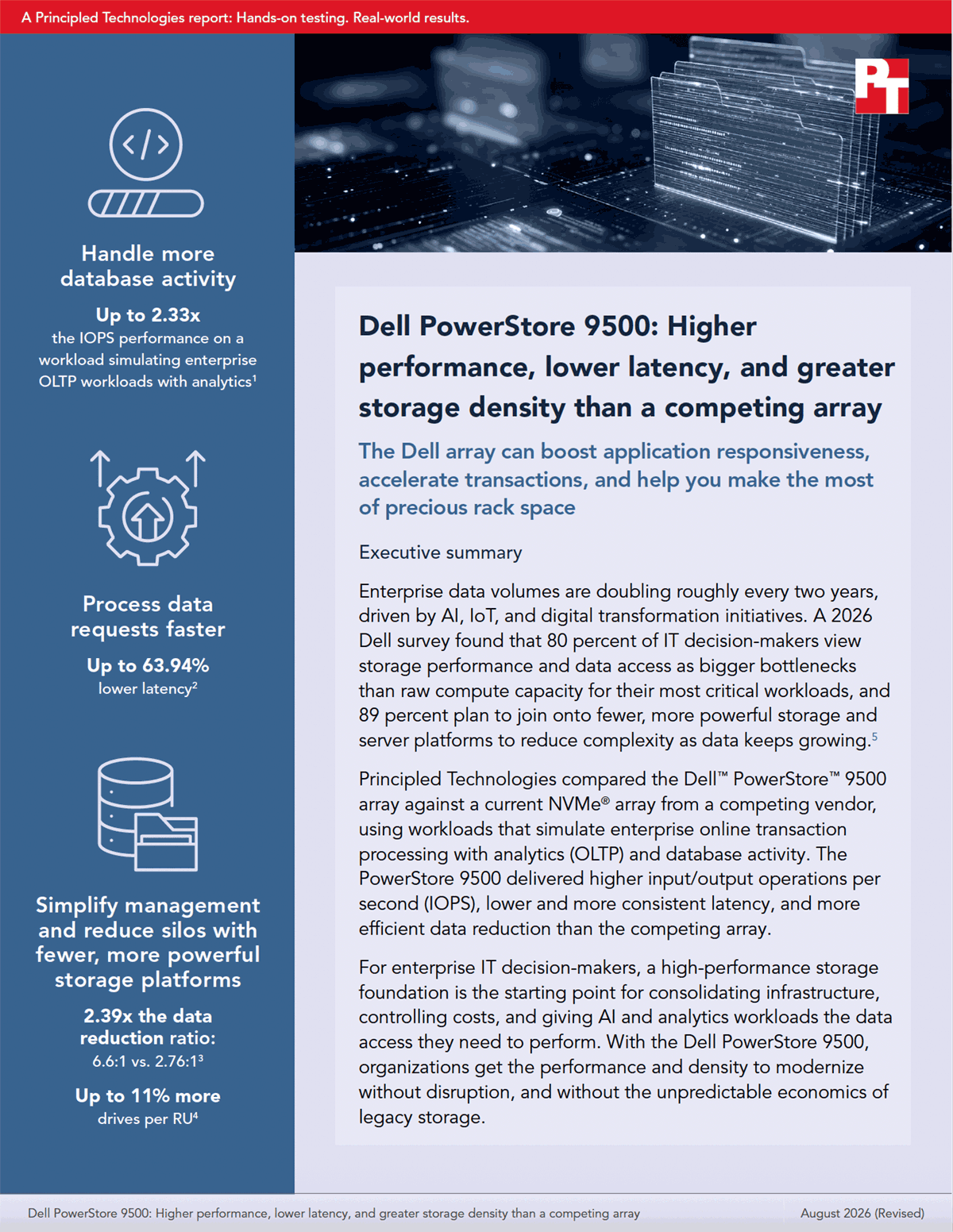
In the OLTP with analytics workload used by Principled Technologies, the PowerStore 9500 delivered 834,558 average IOPS, compared with 357,427 for Vendor A - 2.33 times the performance.
In a separate database test targeting 310,000 IOPS, PowerStore 9500 recorded 63.94% lower latency. Its latency was also more consistent across the test, which can help applications maintain steadier response times under changing workloads.
Getting more from the same footprint
Storage efficiency depends on both physical density and how effectively the system reduces the amount of data that needs to be stored.
PowerStore 9500 supports up to 40 drives in a 3U chassis, which equates to 11% more drives per rack unit than Vendor A's 48-drive, 4U design.
Principled Technologies also measured data reduction using a controlled dataset. PowerStore 9500 achieved a 6.6:1 data reduction ratio, compared with 2.76:1 for Vendor A.
Greater physical density and stronger data reduction can help organizations fit more usable capacity into existing rack space, while reducing the number of drives and systems needed as storage requirements grow.
Designed to grow with demand
PowerStore 9500 can expand capacity one drive at a time, while allowing performance and capacity to scale independently. The platform also supports data-in-place upgrades and mixed-generation clustering across PowerStore models, helping businesses extend the life of existing infrastructure as requirements change.
See how the results were achieved
The full Principled Technologies report sets out the hardware configurations, Vdbench workloads, test environment, and methodology used to compare PowerStore 9500 with Vendor A, and includes the complete performance, latency, and data-reduction results behind the headline findings.
To explore the testing in detail and see how PowerStore 9500 performed across each workload, download the full report, 'Dell PowerStore 9500: Higher performance, lower latency, and greater storage density than a competing array.'
Please provide citations & attributions for any information you generate from this content, thank you.