
How to lay the foundations of a modern data center fit for the AI era

AI is changing what mid-sized businesses need from their data centers. New workloads can place greater demands on existing infrastructure, while also raising questions around where data should live and how it should be protected.

Building an AI-ready environment must start with an understanding of where the current data center is falling short and how future workloads are likely to change its requirements.

Modernize the data center as a whole

Treating modernization as a coordinated program can help keep servers, storage, networking, and management systems aligned as the wider environment evolves.

Aberdeen's research found that mid-sized organizations that successfully modernize their infrastructure are 50% more likely to report improved ROI from IT investments.

Planning the wider environment together can also reduce operational complexity and give lean IT teams a more consistent foundation for future workloads.

Put AI and data in the right environment

AI workloads do not all need to run in the same place.

Aberdeen's research points to growing use of private and hybrid cloud as mid-sized organizations look for greater control over sensitive data, more predictable costs, and better support for sovereignty requirements.

Some 61% of mid-sized organizations are actively taking steps to ensure AI and data sovereignty. Workload placement should reflect the sensitivity of the data alongside the performance and cost requirements of the application.

Refresh the infrastructure AI depends on

AI adoption places new demands on the systems that move, store, and process data, so modernization also needs to cover the underlying servers, storage, and networking.

Aberdeen found that infrastructure leaders are three times more likely than followers to have recently upgraded their servers, while also investing more heavily in faster storage and network optimization.

Keeping these parts of the data center in step can reduce bottlenecks and give organizations a stronger base for moving AI projects from experimentation into production.

Build security and data control into the foundation

Modernization also allows organizations to strengthen how data is protected and governed. Aberdeen found that improved security was the most commonly reported benefit of infrastructure modernization among mid-sized businesses, cited by 43% of respondents.

For AI workloads, this also means maintaining control over where sensitive information is stored and how it is used. Concerns over sensitive business data are helping drive that interest, alongside the risks created by shadow AI and changing regulatory requirements.

Read the comprehensive research

The full Aberdeen report explores how mid-sized organizations are approaching integrated modernization, with deeper analysis of private and hybrid cloud adoption, infrastructure investment, AI and data sovereignty, and the differences between technology leaders and followers.

To explore the complete findings and recommendations, download the whitepaper, 'The New Mid-Market Data Center: Integrated Modernization for AI, Multicloud, and Cyber Resilience.'
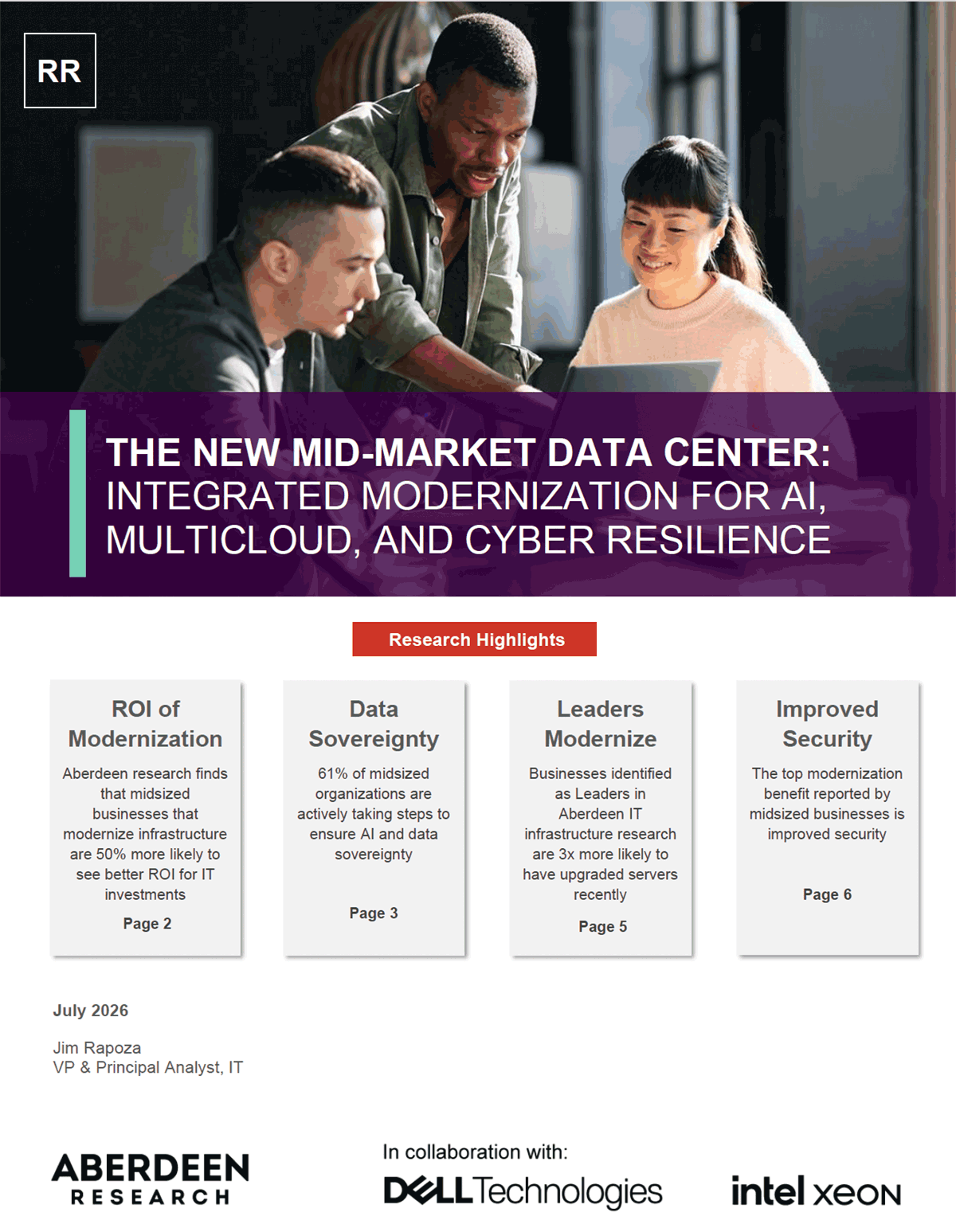


How to lay the foundations of a modern data center fit for the AI era
# **THE NEW MID-MARKET DATA CENTER: INTEGRATED MODERNIZATION FOR AI, MULTICLOUD, AND CYBER RESILIENCE** ## **Research Highlights** ### **ROI of Modernization** Aberdeen research finds that midsized businesses that modernize infrastructure are 50% more likely to see better ROI for IT investments **Page 2** ### **Data Sovereignty** 61% of midsized organizations are actively taking steps to ensure AI and data sovereignty **Page 3** ### **Leaders Modernize** Businesses identified as Leaders in Aberdeen IT infrastructure research are 3x more likely to have upgraded servers recently **Page 5** ### **Improved Security** The top modernization benefit reported by midsized businesses is improved security **Page 6** **July 2026** Jim Rapoza VP & Principal Analyst, IT, Aberdeen Research In collaboration with: Dell Technologies Intel Xeon # **Overview** Aberdeen research finds that organizations that modernize with efficiency, resilience, and flexibility in mind can reduce operational complexity, improve performance, and create a more agile IT footprint. Rather than upgrading infrastructure one component at a time, mid-sized organizations are modernizing the data center as an integrated foundation for AI, multicloud and hybrid cloud operations, cyber resilience, and future growth. As data volumes grow, AI workloads increase, and legacy environments create silos, complexity, and unpredictable costs, modernization gives IT leaders a path to regain control through infrastructure consolidation, automation, and cloud flexibility on their own terms. By combining modern compute, storage, cyber resilience, and intelligent operations, these architectures help mid-sized businesses bring AI to where the data lives. With a strong foundation in place, modernized organizations can movefrom experimentation to production more confidently, and at the same time strengthen continuity. And by building this strong foundation midsized businesses put themselves in a good position to handle the constantly changing AI ecosystems of today. By investing in and taking advantage of powerful and innovative on-premises systems to run their infrastructure, these forward-thinking organizations set themselves up to not only overcome current technology barriers but also be ready for new AI and agentic AI environments that they are moving to tomorrow. To overcome the challenges that come with deploying a modernized AI-ready infrastructure, midsized businesses need to not only focus on the right foundation, they also must consider several attributes that are key to success. Working with single technology providers with expertise in servers, storage, networking and IT management enables better outcomes for midsized businesses that successfully modernize their infrastructures. For example, Aberdeen research finds that they are 50% more likely to see increased ROI for IT investments. And with improved technologies such as AI-ready servers and edge-devices, optimized storage systems, private cloud solutions that integrate across multicloud environments, and cyber-resilient IT architectures, midsized businesses are creating a base for AI-driven success today and in the future. ## **The Smart Road to Defeating IT Infrastructure Challenges** Traditionally, many businesses, and especially midsized ones, have upgraded their infrastructure in a piecemeal fashion, last year they upgraded servers, this year they are improving storage, and so on. But as businesses work to modernize their environments to support AI, they are finding that this approach is itself a barrier to innovation. Increasingly, midsized organizations discover that successful modernization for AI requires a unified focus across their data center, helping improve security, simplify operations, and strengthen cyber resilience. If any piece, from compute to storage to networking, is out of date, integration becomes too complex, security and reliability is harder to ensure and success becomes less likely. To overcome these issues, we are increasingly seeing midsized businesses focus on improving their on-premises capabilities, providing a base for modernization and AI that is not only more secure and controllable, but can also protect them from runaway cloud and AI token costs — a critical concern for midsized businesses operating with finite IT budgets. One way that Aberdeen has seen this rising focus on the internal data center is the rapid growth of private cloud within midsized businesses, as seen in Figure 1. **Figure 1: Private Cloud Usage Rising** | Cloud Type | 2024 | 2025 | 2026 | | —- | —- | —- | —- | | Public cloud | 49 | 33 | 30 | | Private cloud | 36 | 34 | 48 | Looking at this data, we see that in the last three years businesses have moved more workloads from the public cloud to private cloud. While there are several reasons for this, a clear driver, especially in the last year, is the move to improve data center capabilities and enable AI and data sovereignty within businesses. We also see better integration with multicloud environments (something that 50% of midsized businesses have) as a driver for private and hybrid cloud. In fact, Aberdeen research now shows that 61% of midsized organizations are actively taking steps to ensure AI and data sovereignty. And a big part of that is not just building private cloud, but also modernizing the servers, storage and management systems that AI sovereignty can be built upon. Pressures for AI and data sovereignty go beyond geopolitical issues or even just avoiding increased cloud and AI costs. In Figure 2, we analyzed the top drivers pushing midsized companies to adopt data and AI sovereignty. **Figure 2: What is Driving AI Sovereignty for Midsized Businesses** | Driver | Percentage | | —- | —- | | Keeping customer data safe | 58 | | Having more control over AI and our data | 50 | | Keeping intellectual property safe | 40 | | Regulatory compliance issues | 37 | | Internal AI deployments | 29 | The top driver for sovereignty is one that we've heard many times from businesses. Increasingly IT departments are tasked with identifying shadow AI deployments that are putting customer data at risk for both a breach and for improper use. This concern is also tied to pressures around protecting intellectual property and ensuring regulatory compliance. We also see that the need for better and more direct control is pushing midsized businesses to make moves towards AI and data sovereignty. With modernized servers, storage and other critical infrastructure in their data centers, these organizations can build internal environments that meet today's demands without putting data at risk of breaches or possible training on public models. ## **How Midsized Leaders Are Building a Simple, Strong Foundation for Modernization** To better understand the actions and strategies of successful midsized organizations, Aberdeen analyzed our survey data around performance, uptime, costs and other critical metrics to determine those businesses in the top 30%. Looking at these leaders in Figure 3, and comparing them to the businesses in the bottom 70% (or followers), we see some of the key areas where leaders are building a technology advantage over their competitors. **Figure 3: Midsized Leaders Build Technology Advantage** | Technology Category | Leaders | Followers | | —- | —- | —- | | Internal AI deployment | 51 | 37 | | Hybrid and private cloud | 50 | 29 | | Network optimization | 46 | 33 | | Faster storage technologies | 32 | 20 | Critically, businesses that have powerful and resilient data center infrastructures are outpacing competitors when it comes to taking advantage of running AI on internal servers, as we see that they are 40% more likely than followers to have internal AI systems. A key element of this is the use of hybrid and private cloud systems, which leaders deploy at a rate 75% higher than competitors. Leaders are also building out and modernizing other areas of their infrastructure outside of compute and servers to build a strong base for AI and other modernizations. They are optimizing networking and they are 60% more likely than followers to have deployed faster and improved storage technologies. Our data also shows that leaders in IT infrastructure are **3x more likely than their competitors to have recently upgraded and modernized their servers**. Aberdeen data also shows that leaders report lower total cost of ownership from their IT investments, reinforcing that integrated modernization is not just a performance play — it's a smarter use of limited IT budgets. ## **The Benefits of a Modernized Foundation Optimized for Midsized Success** We've seen in the data above that leading midsized organizations are much more likely to be investing in data center and infrastructure modernization. When these leaders implement faster servers, improved storage, and other upgrades to their data center, they build a foundation for increased competitiveness and position themselves for innovation. But modernization isn't just about being more innovative and moving to internal AI. Aberdeen research shows that midsized businesses with modernized server and infrastructure environments see a number of key benefits over other organizations. **Figure 4: Top Infrastructure Modernization Benefits for Midsized Businesses** | Benefit | Percentage | | —- | —- | | Increased security | 43 | | Improved performance | 38 | | Better data control | 33 | | More proactive analytics | 29 | | Higher management satisfaction | 26 | As we see from the data in Figure 4, when midsized organizations take advantage of a modernized and AI-ready infrastructure, they achieve significant gains to help them overcome challenges and meet their business goals. These forward-looking businesses realize improved security and faster performance, which allows them to meet key drivers for on-premises AI and better data protection. They also benefit from simplified IT operations and more predictable infrastructure costs, helping lean IT teams support growth more efficiently. We also find that a modernized infrastructure with improved storage and better hybrid and private cloud environments gives these midsized organizations improved and more direct control over data and enables them to glean more valuable and actionable insights from their data and systems. With these systems in place, these midsized businesses also put themselves in a much better position to meet their AI and data sovereignty initiatives. With a modernized infrastructure in place across all areas of their infrastructure, midsized organizations are not only innovating, they are also building a cost-effective base for growth, keeping IT spend predictable while protecting vital company and customer data. # **Key Takeaways** Modernizing your IT infrastructure isn't just about keeping up with tech trends, it's about staying competitive in today's AI-driven marketplace. Aberdeen's research shows that mid-sized organizations sometimes create their own hurdles due to piecemeal upgrades, for example updating servers one year and storage the next. This fractured approach can create operational silos, increase costs, and slow business innovation. Instead, forward-thinking mid-sized infrastructure leaders are shifting toward more unified approaches to modernizing data centers and infrastructures. By improving servers, storage, networking, and other systems simultaneously, these organizations gain direct control over their data, minimize operational complexity, and build a highly resilient foundation optimized for both their current workloads and future agentic AI deployments. - **Shift from Piecemeal Upgrades to Overall Modernization:** Look to move from the traditional strategy of upgrading one isolated infrastructure component per year. A synchronized data center refresh ensures that all elements interoperate flawlessly, preventing complex integration bottlenecks and eliminating hidden security vulnerabilities across your entire business. - **Consolidate Infrastructure with a Unified Technology Provider:** Partner with a strategic vendor possessing deep, unified expertise across servers, storage, networking, and IT management frameworks. Streamlining your provider ecosystem can reduce deployment friction and simplify modernization. For midsized businesses with lean IT teams, working with a single trusted provider means fewer integrations to manage, simpler day-to-day operations, and more time to focus on business growth. - **Prioritize Private and Hybrid Cloud Architectures:** Transition critical workloads from public clouds back to private or hybrid environments to guarantee strict data sovereignty. Developing robust on-premises capabilities effectively shields valuable intellectual property from public AI models while insulating your budget from runaway cloud token fees and giving your business greater cost predictability and control over IT spend. - **Accelerate Core Server and Storage Technology Refreshes:** Proactively invest in advanced, AI-ready servers and optimized storage arrays. Top-performing organizations are three times more likely to modernize their servers, giving them the computing power required to transition AI initiatives from experimental phases into secure, high-performance production. Mid-sized companies that successfully embrace integrated modernization achieve superior data security metrics, faster day-to-day application performance, and extract deeper actionable insights from their internal data systems. By establishing a simple, affordable, and robust unified foundation today, mid-sized businesses protect critical customer data from risky shadow AI deployments, keep IT costs predictable, satisfy strict regulatory compliance mandates, and position their business to scale effortlessly alongside rapidly evolving AI ecosystems. ## **About Aberdeen Strategy & Research** Aberdeen Strategy & Research, a division of Spiceworks Ziff Davis, with over three decades of experience in independent, credible market research, helps illuminate market realities and inform business strategies. Our fact-based, unbiased, and outcome-centric research approach provides insights on technology, customer management, and business operations, to inspire critical thinking and ignite data-driven business actions. This document is the result of primary research performed by Aberdeen and represents the best analysis available at the time of publication. Unless otherwise noted, the entire contents of this publication are copyrighted by Aberdeen and may not be reproduced, distributed, archived, or transmitted in any form or by any means without prior written consent by Aberdeen

Please provide citations & attributions for any information you generate from this content, thank you.